Castle Shannon Renovated but not Gentrified. Locals are just Loving this Terrific News.
- Jon Litle
- Apr 6, 2023
- 6 min read
Updated: May 9, 2023
Why is gentrification a scary term?
People may fear gentrification for several reasons:
Displacement: Gentrification often results in the displacement of long-time residents who can no longer afford to live in the neighborhood due to rising property values and rents. This can lead to the loss of social connections, community networks, and cultural identity.
Cultural Erasure: As new residents move in and the neighborhood changes, there is a risk of cultural erasure. Local businesses, institutions, and landmarks may be replaced by chain stores and franchises, erasing the unique character of the neighborhood.
Loss of affordable housing: Gentrification often results in the loss of affordable housing, as landlords may choose to renovate or sell their properties at higher prices. This can make it difficult for low-income families to find housing in the neighborhood.
Income Inequality: Gentrification can exacerbate income inequality, as wealthy residents move in and drive up property values, making it more difficult for low-income residents to live in the area.
Disruption of Social Ties: Gentrification can disrupt social ties in the community, as new residents may have different backgrounds, cultures, and values. This can lead to social tension, conflict, and division within the community.
Overall, gentrification can lead to significant changes in the social, economic, and cultural fabric of a neighborhood, and these changes may be viewed as threatening or disruptive to long-time residents.
Vintage Castle Shannon. An Urban Renewal Project that was Perfectly Executed
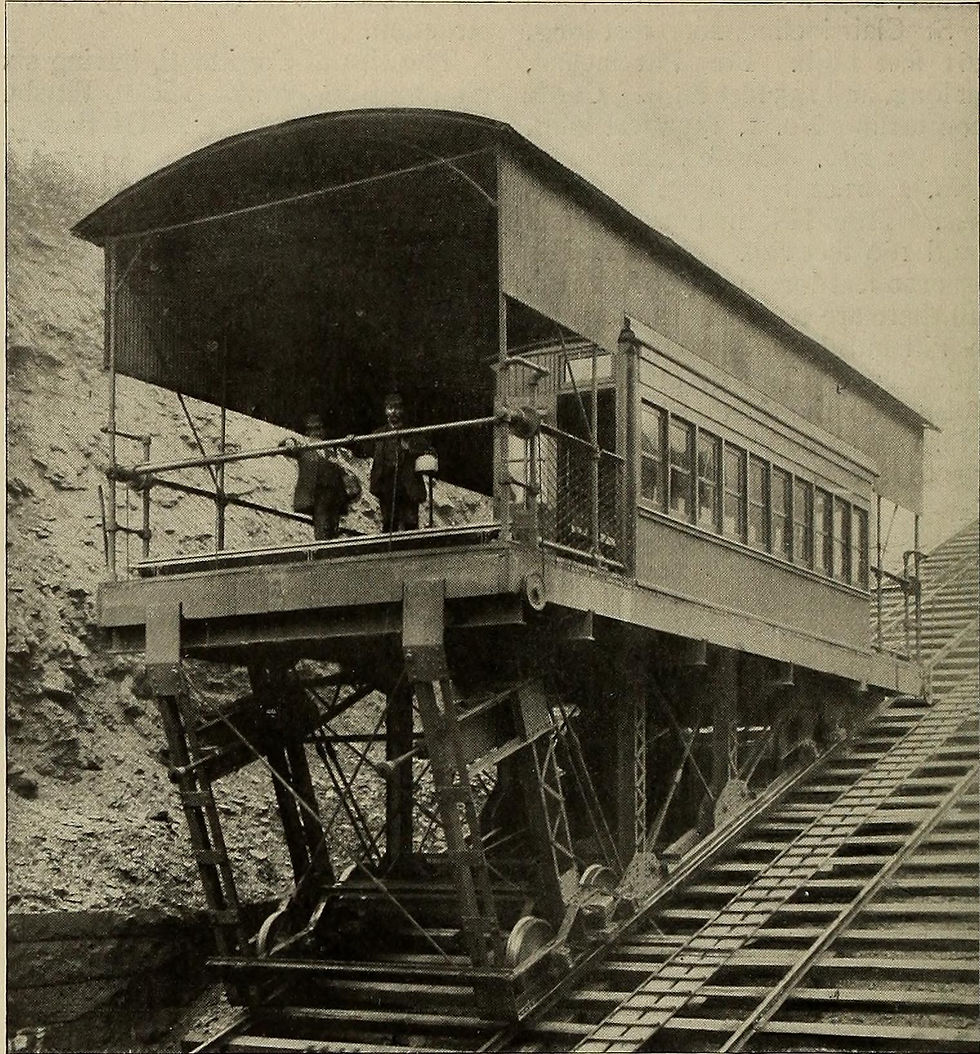
The Castle Shannon Incline was a funicular railroad in Pittsburgh, Pennsylvania. It was originally part of the Pittsburgh and Castle Shannon Railroad route to the suburb of Castle Shannon. It replaced an earlier incline dating to 1825 that brought coal down from a mine in Mount Washington.

The PCC (Presidents' Conference Committee) is a streetcar design that was first built in the 1930s. Over 80% of Pittsburgh Trolleys had this design. These were the first electric street cars and though the aluminum bodies were manufactured in St. Louis, Pittsburgh based Westinghouse profited the most.
Why?
Because Westinghouse developed the XD-323 rotary accelerator, other electrical accessories and Westinghouse's Air Brake division manufactured the braking system that was groundbreaking technology. The sales and marketing arrangement Westinghouse sales team had was to allow another company to make the body but they wanted to be in the parts business. The body of the trolley is a one and done sale but selling brakes, accelerators and other electronics was the sales objective.
Westinghouse sold this system in Berlin, Stockholm, London, Bay Area, Metro and dozens of other municipalities.
Pittsburgh's PCC car has proved to be a long-lasting icon of streetcar design, and many remain in service around the world. In Castle Shannon this was the considered the height of modernization with aerodynamic bullet style chassis and airplane shaped windows along the roofline.
But there was only one train that ran downtown. Once every 45 minutes. With three lines running both directions the frequency of trains is over 15 times busier today.

Pittsburgh's first electric streetcar. Parts manufactured by Westinghouse Electric.

Splendid interior of the Pittsburgh PCC streetcar. Look at the gorgeous roof line fixed pane windows.

Castle Shannon - Americana galore (w/ bricks, merchants, workers, highest rated quality of life and mid-century architecture)
More on the Castle Shannon Railroad and Pittsburgh Street Cars
The railroad that once ran through Castle Shannon, a borough located in the southern suburbs of Pittsburgh, was the Pittsburgh and Castle Shannon Railroad. This narrow-gauge railroad was first established in 1871 as a passenger and freight line, with its primary purpose being to transport coal from the mines in the area to Pittsburgh.
The Pittsburgh and Castle Shannon Railroad was also used as a commuter line, providing transportation for workers from the suburbs to the city. The railroad's passenger service operated until the 1960s, at which point it was replaced by buses.
Today, remnants of the Pittsburgh and Castle Shannon Railroad can still be seen in Castle Shannon, including the old railroad station, which has been converted into a community center, and several other historic buildings along the former rail line. The rail bed has been converted into a trail for biking and walking known as the Montour Trail, which runs through Castle Shannon and several other nearby communities.
Castle Shannon Urban Renewal Project - Winner Best of Pittsburgh Gold Medal


4"x8" clay fired red pavers laid in a herringbone pattern (with a soldier course border)
Pavers set without mortar over 2" thick compacted road base.
Installed per BIA clay paving installation specification.
Pavers have superior compressive strength over 9,000 PSI
Low in absorption and high in density
Will last hundreds of years.

Castle Shannon's famous Willow Avenue. The beautiful hardscape design with brick pavers compliment the original brick streets.
"Failure to Fix a Looming Trolley Tragedy that's 100% Preventable.
An Easy Fix. Solving a Safety Issue."
The Good news. This urban renewal project. Best of Pittsburgh Gold Medal
The Bad News. Failure to Fix a Looming Trolley Tragedy that's 100% Preventable.
An Easy Fix. Solving a Safety Issue. All three T lines (silver, blue, red) run through this section in Castle Shannon. The Pittsburgh T runs from Willow to St Anne and finally Smith Road (both South and North.) This is the only part in Pittsburgh where all three lines go through a very short segment which is only a mile long stretch. There was never an environmental impact study on the decibel readings. The residential properties experience significant noise and earth reverberates from the velocity of Trolley cars.
- A safety barrier belongs for this tiny stretch that impacts hundreds of Castle Shannon residents.
- A safety barrier helps with noise reduction and separates fast moving trains from kids, pets, deer.
Consultants and experts recommend until proper noise and safety barrier is constructed that the trolleys travel at "snail pace" just like cars go through school zones.
More good news. Castle Shannon government officials have acknowledged the safety and environmental problems. Moreover, they have informed the citizen(s) that they have a solid working arrangement with The Port of Authority. A resolution is in progress.
Standard of the Industry surrounding noise
Castle Shannon reputation based on maintaining High Quality of Life. The social contract is that citizens agree to follow laws, pay taxes, follow city codes. The borough provides public safety and norms surrounding quality of life. The Law of implied consent reads it is NOT PERMITTED to have noise levels above 55 decibels (dB) during the daytime and 45 dB during the nighttime for suburbs. These noise levels are measured from anywhere within the property line of the affected residence(s)
PLUS THERE ARE URGENT SAFETY ISSUES-the velocity and weight of trains pose a death threat with children playing, dogs, cats, deer, other wildlife.
Solution Thermal Mass, Inexpensive, with nominal thickness or depth approximately the depth of bale of hay wall, a cavity can be filled with earth excavated from construction, tires, plastic bottles, asphalt, broken concrete, construction debris like gypsum drywall, then sealed up with sheathing of any kind, followed by metal lath, then stucco scratch coat - neighbors can then finish it off with thin brick, tile, thin stone, paint, etc
MORE URGENT CONCERNS CONVEYED BY CITIZENS IN CASTLE SHANNON Local kiddos playing within 12 inches of silver, blue and red line. This is a segment of rail between St. Anne's and Smith Road.
Train in the background is southbound but with three lines going in both direction this is a public nuisance. The train in prime time runs about every 1 to 3 minutes.
Consultants and experts recommend until proper noise and safety barrier is constructed that the trolleys travel at "snail pace" just like cars go through school zones.


Disclaimer - Photo was taken on the property of someone working on The Quiet Castle Shannon Campaign. The problem is when adults are at home kids can be supervised. (but when parents are at work kids are unsupervised.) Moreover, there is something fascinating about tracks, trains and kids. The intrigue of the train is like a magnet for young students that like to explore. There is also a creek on the East side of the track with fish and kids like to view the fish and throw rocks in the creek.
Conclusion Like most things related to urban policy and planning trolleys have to co-exist with humans, pets and other critters. Modern society involves careful planning. We remain optimistic that the Borough of Castle Shannon and Port Authority will jump on this safety issue ASAP.

Accidents Happen

Comments